
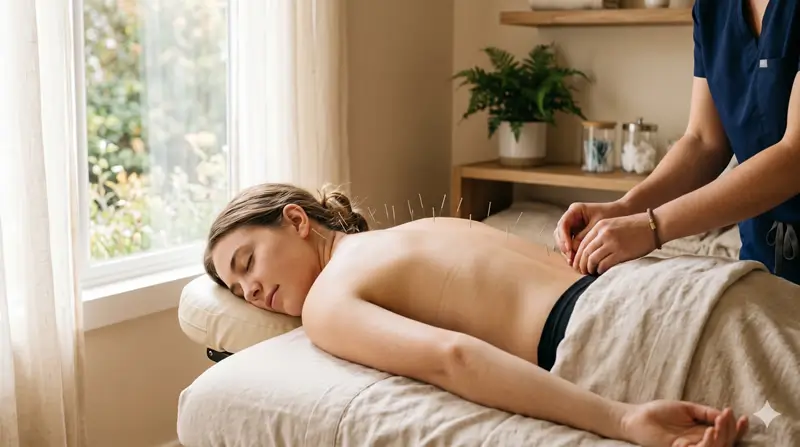
Taylor came into our Winter Park clinic at 21 years old, carrying something most people don’t expect to see on someone so young, years of migraines. Not occasional headaches, not stress tension that fades by morning. Migraines. The kind that pull you out of class, cancel your plans, and make you wonder whether this is just going to be your life.
Two dry needling sessions and two weeks of herbal support later, Taylor had already experienced a 50% reduction in both the intensity and frequency of her migraines. Not a cure, not a promise, but real, measurable progress, the kind she hadn’t found anywhere else.
If you’ve been living with migraines and feel like you’ve tried everything, her story might sound familiar. And it might be worth understanding what dry needling is actually doing, and why it’s different from what you’ve likely been offered.
First, What Is Dry Needling, and How Does It Fit Within Acupuncture?
This is one of the most common questions we get, and it’s worth clearing up a widespread misconception. Dry needling and acupuncture aren’t two separate things, dry needling is actually a form of acupuncture. Both use the same thin filiform needles, and according to Jan Dommerholt, one of the world’s leading authorities on the subject, dry needling falls within the broader practice of acupuncture.
What many people don’t realize is that acupuncture is not a single technique, it’s a wide field that encompasses many different approaches. Trigger point acupuncture, which is what dry needling is, is one of those. Not all acupuncturists practice meridian therapy or work with the concept of qi. As a licensed acupuncturist, Dr. Jon’s training spans multiple needle-based approaches, including the precise trigger point work that makes dry needling so effective for musculoskeletal pain and migraines.
This matters for you as a patient because it means you’re not receiving a watered-down or imitation technique. You’re receiving specialized acupuncture from someone trained at the highest level in this specific application.
The Muscle and Soft Tissue Connection to Migraines
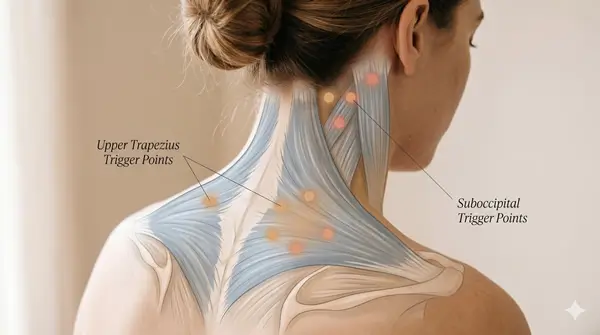
A lot of migraine sufferers are surprised to learn that the muscles of the neck, upper back, shoulders, and base of the skull play a significant role in migraine onset and severity. When trigger points are active in these areas, especially in the suboccipital muscles at the base of your skull, or the upper trapezius and sternocleidomastoid, they can directly refer pain into the head, behind the eyes, and across the temples.
These trigger points can be activated by stress, poor posture, old injuries, or simply patterns of tension that have built up over time. For many migraine patients, this soft tissue component has never been addressed, because most conventional migraine treatments don’t look there.
This is precisely where dry needling becomes meaningful. By releasing the trigger points contributing to your headache pattern, we can reduce one of the physical inputs that may be driving your migraines in the first place.
Training That Goes Well Beyond the Basics
Not all dry needling is the same, and that’s an understatement. There are currently around 60 companies teaching dry needling across the country, and the term itself gets applied to a wide range of techniques: trigger point needling, needle retention, retention with electrical stimulation, and in some cases, approaches that are indistinguishable from traditional acupuncture. The quality and rigor of these trainings varies enormously, and as a patient, it’s nearly impossible to know what you’re actually getting.
Myopain Seminars is the exception. It’s widely regarded as one of the most, if not the most, rigorous and research-based dry needling training programs available. The curriculum is grounded in evidence, the standards are high, and safety is central to everything taught.
Dr. Jon trained directly under Jan Dommerholt, the founder of Myopain Seminars and one of the world’s foremost authorities on dry needling and myofascial pain. He also serves as an assistant instructor with the program, helping train clinicians internationally.
Beyond that, Dr. Jon holds the CMTPT, Certified Myofascial Trigger Point Therapist, one of the most advanced and respected credentials in this field. This certification recognizes practitioners who have demonstrated a high level of clinical competency specifically in the assessment and treatment of myofascial trigger points. It’s not a weekend course or an online certificate. It represents a deep, specialized body of knowledge that directly shapes how every patient at Orlando Alternative Health is evaluated and treated.
What to Expect as a New Patient
When you come in for the first time, we don’t go straight to treatment. We start with a thorough health history, and depending on your presentation, may perform an orthopedic examination to understand the structural picture, what’s tight, what’s restricted, what’s referring pain and where.
This assessment guides the treatment. We want to understand your specific pattern, not apply a generic protocol.
Most patients notice a meaningful difference somewhere in the range of two to four sessions. Some notice it sooner. The goal with each session is:
- Release active trigger points contributing to your headache pattern
- Restore more normal function to the soft tissue around the neck and upper back
- Reduce the physical load your nervous system is carrying
- Give your body a better baseline between migraine episodes
Why We Combine Dry Needling with Acupuncture
Dry needling addresses the mechanical and musculoskeletal side of migraines. Acupuncture works on a different level, supporting the body’s internal regulation, addressing the systemic patterns that Traditional Chinese Medicine identifies as root contributors to chronic headache conditions.
For many of our patients, Taylor included, the combination of both is what creates a result that neither approach fully delivers alone. This is the integrative nature of what we do at Orlando Alternative Health: using the best tools available, East and West, to address your migraines from multiple directions at once.
This content is for educational purposes only. It is not intended as medical advice. If you are currently taking prescription medications, please consult your physician before making any changes to your treatment plan.
If you’re ready to take a different approach to your migraines, we’d love to learn more about your situation. Reach out to Orlando Alternative Health in Winter Park to schedule a consultation, and let’s find out what’s actually driving your headaches.Serving patients throughout Orlando, Winter Park, Maitland, and the surrounding Cen